Netherlands
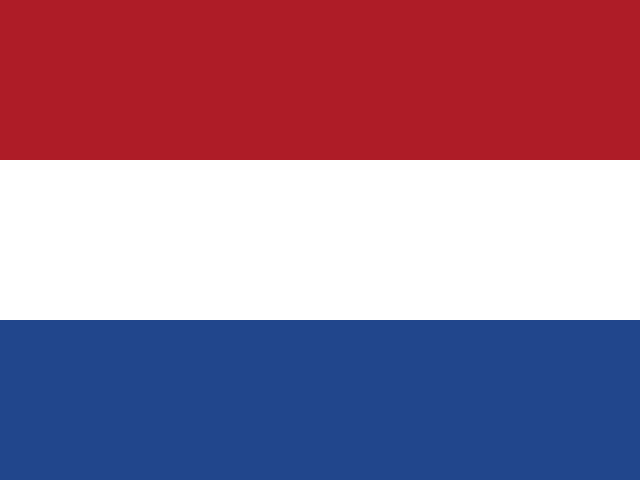 Netherlands
- International code
- NL
- ISO code
- NL / NLD
- Data status
- Verified
Plates carry no regional meaning. Plates carry no regional meaning, so there is no region to show.
MapDriving in Netherlands: plates, vignettes and zonesCurrent plate formats
- StandardSince 2024GBB-01-B
Three letters, two digits, one letter (sidecode 11 in Dutch usage, used for cars from 4 June 2024; mopeds had it from 2015). Black on yellow with the EU strip. Only consonants are used (no vowels, C, M, Q or W), and the number stays with the vehicle, not the owner.
black on yellow
Make this plate →
Older formats
No longer issued, but some may still be on the road.
- Standard2019–2024G-001-BB
Sidecode 10, one letter, three digits, two letters. First car plate (G-001-BB) issued on 19 August 2019.
black on yellow
Make this plate → - Standard2015–2019GB-001-B
Sidecode 9, two letters, three digits, one letter. First car plate (GB-001-B) issued on 30 March 2015.
black on yellow
Make this plate → - Standard2013–20151-KBB-00
Sidecode 8, one digit, three letters, two digits. First car plate issued on 5 March 2013. Only K, S, T, X and Z are used as the first letter on cars.
black on yellow
Make this plate → - Standard2008–201300-GBB-1
Sidecode 7, two digits, three letters, one digit. Issued to cars from 19 May 2008 (sidecode 6 ran out); the same layout was used for mopeds from 2005.
black on yellow
Make this plate → - Standard1999–200801-DB-BB
Sidecode 6, two digits, two letters, two letters. Issued from 1999 until 19 May 2008. Since the controlled-issue (GAIK) plates of 2000 they carry the EU strip.
black on yellow
Make this plate → - Standard1978–1999DB-01-BB
Sidecodes 4 (XX-99-XX, from mid-1978) and 5 (XX-XX-99, from 1991). Yellow reflective plates became mandatory on 1 January 1978. Plates remade since 2000 carry the EU strip.
black on yellow
Make this plate → - Standard1951–1978AB-12-34
Sidecodes 1 (XX-99-99, 1951 to 1965), 2 (99-99-XX, 1965 to 1973) and 3 (99-XX-99, 1973 to 1978), in three pairs of two characters. White on dark blue; light blue plates followed in 1976 and 1977, and yellow reflective plates were optional from October 1975. Vehicles registered before 1 January 1978 may still use dark-blue plates.
white on blue
Make this plate →
History
- 1898
First plates, introduced on 26 April. The Netherlands was the third country to introduce them.
- 1906
Province code plus serial number (xx-ddddd).
- 1951
The current national system, numbered in strict time order and tied to the vehicle.
- 1978
Yellow reflective plates become mandatory on 1 January; dark blue plates stay allowed for vehicles registered earlier.
- 2000
The blue EU strip with NL becomes mandatory on new plates.
Related countries
EU-style plates
 Austria
 Belgium
 Bulgaria
 Croatia
 Cyprus
 Czechia
 Denmark
 Estonia
 Finland
 France
 Germany
 Greece
 Hungary
 Ireland
 Italy
 Latvia
 Lithuania
 Luxembourg
 Malta
 Norway
 Poland
 Portugal
 Romania
 Slovakia
 Slovenia
 Spain
 Sweden
Sources
- Wikipedia (Dutch), Nederlands kenteken · CC BY-SA 4.0 · retrieved November 10, 2026
- licenseplatemania.com, Netherlands (Nederland) · retrieved November 10, 2026
- Wikipedia, Vehicle registration plates of the Netherlands · CC BY-SA 4.0 · retrieved November 9, 2026
- mledoze/countries (world-countries 5.1.0) · ODbL-1.0 · retrieved November 8, 2026
- Wikidata, property P395 · CC0-1.0 · retrieved November 8, 2026
Checked against at least two independent sources.